
Crypto Trading Tax in India: Records, Tax Treatment, and Filing Basics


Anyone involved in crypto trading in India eventually has to think about how crypto assets are taxed. Since the Union Budget 2022, cryptocurrencies, NFTs, and other qualifying holdings have been classified as Virtual Digital Assets (VDAs) under the Income Tax Act, and this classification shapes almost every tax implication that follows — from how profit from crypto is calculated to how it is eventually reported.
Crypto trading tax in India is not one single rule but a combination of elements: a flat tax on gains, a separate 1% TDS mechanism applied to transfers, restrictions on how losses can be used, and specific reporting requirements through Schedule VDA in the income tax return (ITR). This article introduces these topics factually, without offering personalised tax or investment advice, and focuses on the records and concepts commonly discussed in relation to cryptocurrency tax in India.
Key Takeaways
- Income from the transfer of Virtual Digital Assets is commonly described as taxed at a flat 30% under Section 115BBH of the Income Tax Act, with cess (and surcharge, where applicable) added on top.
- Tax liability for the year on crypto gains is distinct from the 1% TDS already deducted on crypto transfers — TDS is a collection mechanism, not the final amount of tax owed.
- Transaction-level records, including acquisition cost and the market value on the date of transfer, are commonly described as central to accurately working out tax on crypto.
- Schedule VDA in the applicable ITR form is used to report each qualifying transaction, supporting ITR filing for anyone earning income from exchanges or self-custody wallets.
- Losses arising from crypto transfers are subject to specific set-off restrictions under the current tax regime and generally cannot be adjusted against other income or, in many cases, other VDA gains.
Crypto Tax Rules in India
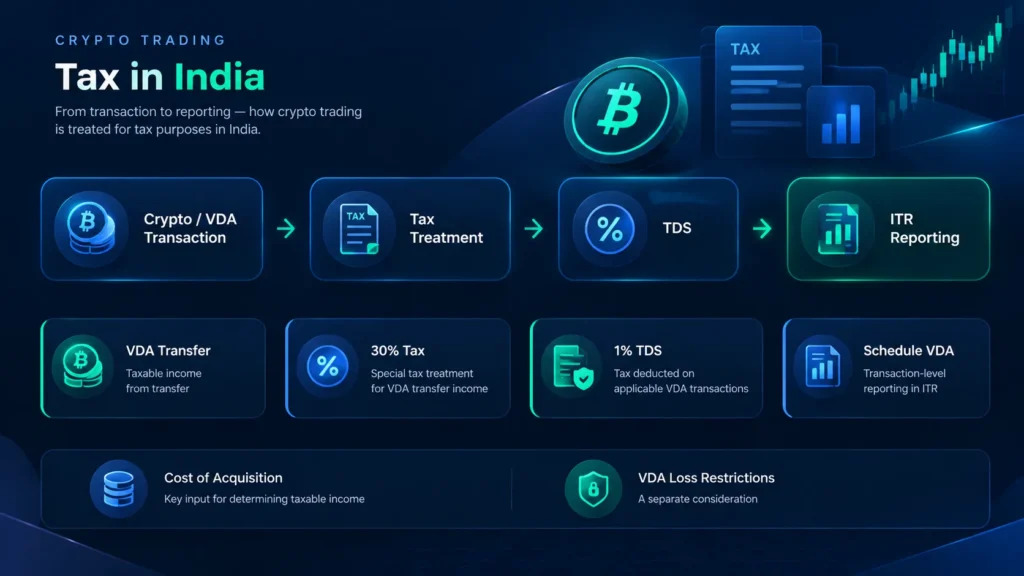
Crypto tax rules in India sit within the broader Income Tax Act framework, applied specifically to a category called Virtual Digital Assets. The rules cover how gains from crypto assets are classified, taxed, and reported, as well as how TDS interacts with the eventual filing process handled by the income tax department.
Virtual Digital Assets Under Indian Tax Rules
Cryptocurrencies, NFTs, and other qualifying assets are grouped under the term Virtual Digital Asset, a definition introduced into the Income Tax Act as part of the Union Budget 2022. This classification matters because it places Indian crypto transactions under a dedicated tax provision rather than the general capital gains framework used for shares, mutual funds, or bonds. Once an asset is treated as a VDA, its transfer is generally evaluated under Section 115BBH rather than ordinary capital gains rules.
30% Tax Treatment for VDA Transfers
Income from the transfer of a VDA is commonly described as taxed at a flat 30 percent rate, with an additional 4% health and education cess and, in some cases, applicable surcharge. This treatment is often described as different from the regular income tax slab system, since profit from crypto is taxed at a flat 30 uniformly, regardless of the taxpayer’s applicable income tax slab or how long the asset was held before transfer. Because the rate is fixed, crypto gains do not benefit from the graduated structure used elsewhere in the tax regime, and traders are generally expected to pay tax on the full amount of taxable income at that flat rate.
Cost of Acquisition and Deductible Amounts
Cost of acquisition refers to the amount originally paid to acquire a crypto asset, and it is the primary figure used to calculate taxable income when the asset is later transferred. Under the current framework, deductions beyond the cost of acquisition — such as transaction fees, internet costs, or other trading-related expenses — are generally not permitted. This is a notable departure from how expenses are treated for other asset classes, where certain related costs can sometimes reduce taxable gains before the tax liability for the year is finalised.
Crypto Losses and Set-Off Restrictions
Losses from crypto transfers are treated differently from losses on many other asset classes. A loss on one transaction is commonly described as unable to be set off against gains from another crypto asset, and losses generally cannot be adjusted against income from other sources such as salary or business income. These losses also typically cannot be carried forward to future years, which increases the importance of maintaining detailed transaction-level records to support the figures eventually submitted to the tax department.
| Aspect | Typical Treatment for Crypto Assets | Typical Treatment for Other Capital Assets |
| Tax rate | Taxed at a flat 30 (plus cess) | Varies by asset type and holding period |
| Deductible expenses | Cost of acquisition only | Cost of acquisition, improvement, and certain expenses |
| Loss set-off | Restricted; generally not offset against other crypto gains or other income | Often permitted against gains within the same head, subject to rules |
| Carry-forward of losses | Generally not permitted | Often permitted for a limited number of years |
Crypto Transactions That Can Have Tax Consequences
Several distinct types of activity can trigger a taxable event under the VDA framework, not only a straightforward sale for cash. Recognising these categories helps clarify why crypto tax obligations extend well beyond simple exchange-based sales.
Selling Crypto for INR
When a crypto asset is sold for Indian rupees, the transaction can create income taxable as income under the VDA framework, based on the difference between the transfer value received and the cost of acquisition. The consideration received, along with the market value on the date of the transfer, are both relevant when calculating the resulting figure for that particular transaction.
Crypto-to-Crypto Swaps
Exchanging one cryptocurrency for another can constitute a VDA transfer even though no INR is received at the time of the swap. Because a transfer of assets has occurred, this type of transaction is often treated as relevant for tax purposes. Recording the market value on the date of both assets involved in the swap is generally considered important for establishing the transaction’s tax implications.
Crypto Spending and Other Transfers
Using cryptocurrency to pay for goods or services, or transferring it in other non-sale forms, can still fall within the definition of a VDA transfer. A transaction may carry tax relevance even when it does not resemble a conventional sale through crypto exchanges, since the underlying event is the transfer of the asset rather than the specific mechanism used.
Mining, Staking and Airdrop Income
Crypto received through mining, staking, or airdrops is often treated separately from gains or losses that arise later when those same assets are transferred. The initial receipt may be evaluated under general income tax provisions, potentially at the applicable income tax slab rate, while a subsequent sale or swap of the received tokens is then assessed under the VDA transfer rules. This two-stage treatment is one reason these categories are sometimes discussed separately from simple buy-and-sell activity involving crypto in India.
1% TDS on Crypto Transactions
Tax Deducted at Source, commonly referred to as TDS, applies alongside income tax on crypto transfers and is deducted at the time of the transaction itself rather than at the end of the financial year.
Section 194S and VDA Transfers
Section 194S introduced a 1% TDS requirement connected to the transfer of Virtual Digital Assets. TDS in this context functions as a collection mechanism — an amount withheld during the transaction — rather than representing the final tax liability owed on that income. The final tax on crypto is determined separately when the transaction is included in the taxpayer’s overall computation for the year.
TDS Thresholds and Who Deducts Tax
Responsibility for deducting TDS can depend on the nature of the transaction and the parties involved, including whether it takes place through crypto exchanges based in India or elsewhere. Thresholds are commonly discussed in relation to annual transaction value, and different thresholds are sometimes described for specified categories of taxpayers compared to others. Because these figures can be updated through official notifications, tax experts generally recommend reviewing the currently applicable thresholds before relying on them.
TDS on Sale Value Versus Crypto Profit
TDS is connected with the transaction’s consideration — broadly, the value exchanged — while income tax is calculated on taxable income, meaning the profit after accounting for the cost of acquisition. A simple illustration: if a crypto asset worth ₹1,00,000 is sold, 1% TDS (₹1,000) may be withheld on that consideration, while tax on crypto gains is separately calculated on the actual profit realised from that sale, which could be a different amount entirely. This distinction between crypto transfers and the profit they generate is often highlighted because the two figures are calculated on different bases.
TDS Credits in Form 26AS and AIS
Amounts deducted as TDS typically appear in a taxpayer’s Form 26AS and the Annual Information Statement (AIS), both commonly used as reference documents during itr filing. Discrepancies between records from crypto exchanges, Form 26AS, AIS, and the eventual ITR entries can create reconciliation issues, which is one reason cross-checking these sources against the income tax department’s data is frequently recommended in general tax literature.
Crypto Tax Records to Keep
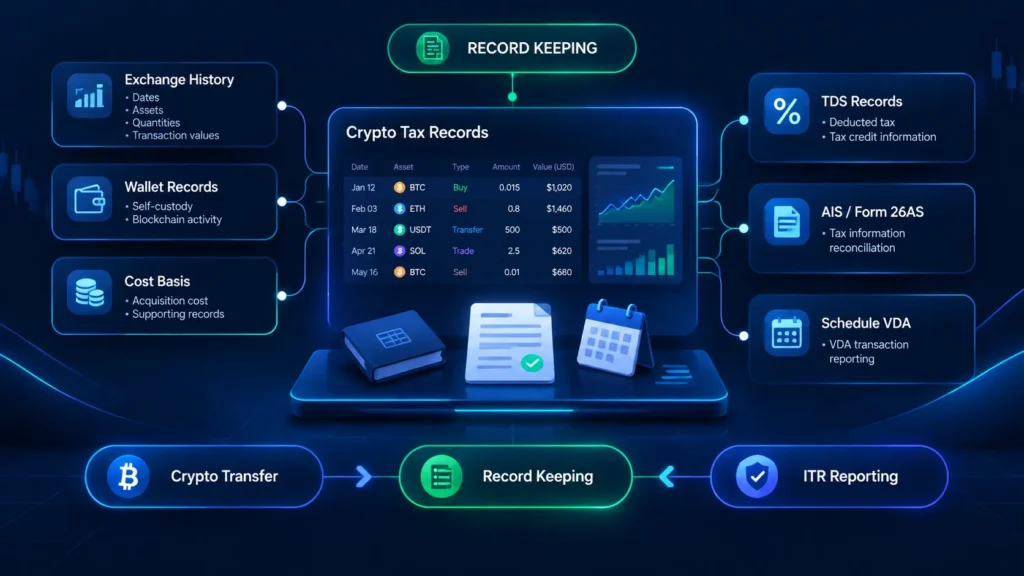
Maintaining organised records is widely described by tax experts as central to accurately reporting crypto transactions, particularly given the transaction-level detail required by Schedule VDA.
- Exchange transaction history from crypto exchanges, including trade dates, quantities, and identifiers
- Wallet addresses and on-chain transaction records for self-custody activity
- Acquisition cost documentation for each asset held
- TDS certificates, exchange statements, and downloaded AIS/Form 26AS data
- Records of transfers, swaps, airdrops, staking rewards, and mining receipts
- Notes distinguishing internal transfers (between a user’s own wallets) from disposals
Exchange Transaction History
Complete records from crypto exchanges — covering trade dates, quantities, asset names, acquisition values, transfer values, and transaction identifiers — are commonly described as a foundational source of information for tax calculations. Most Indian crypto exchanges provide downloadable statements, which can serve as a starting point for compiling a full transaction history across a tax year.
Wallet and Blockchain Records
Self-custody wallets and on-chain transactions do not automatically appear in an Indian exchange statement, so separate records are often needed to capture this activity. Blockchain explorers and wallet export tools are commonly used to reconstruct transaction histories that fall outside centralised platforms, which matters for anyone holding indian crypto across multiple environments.
Cost Basis and Acquisition History
Establishing the acquisition cost of each crypto asset, including supporting evidence, is generally considered important when holdings move between multiple exchanges or wallets over time. Without clear acquisition records, calculating income taxable as income from a later transfer becomes more difficult, particularly across a tax year involving several platforms.
TDS and Tax Documents
Relevant documents in this category include TDS certificates, periodic exchange statements, Form 26AS, and the AIS. These documents are commonly used together to reconcile the TDS amounts already deducted against the transactions reported in the taxpayer’s own records, supporting a smoother interaction with the tax department if questions arise.
Calculating Taxable Crypto Income
Calculating tax on crypto gains generally starts with a transaction-by-transaction comparison of what was paid to acquire an asset against what was received when it was transferred.
Sale Value and Cost of Acquisition
The basic relationship used to determine taxable gains compares the transfer consideration received — often benchmarked against the market value on the date of transfer — against the cost of acquisition for that specific asset. This calculation is applied at the level of each individual transaction rather than as an aggregate figure across a portfolio.
Multiple Transactions During the Tax Year
Frequent purchases, sales, and swaps can make transaction-level reconciliation especially important, particularly where activity spans several crypto exchanges and wallets. Each transaction is commonly treated as a separate taxable event, so maintaining a consolidated record across platforms can help avoid gaps or duplication when the total tax liability for the year is calculated.
Loss-Making Transactions
Losses can appear within a transaction history even while remaining subject to the specific restrictions that apply to crypto losses under the current tax regime. A transaction showing a loss is still generally recorded, since it can be relevant to understanding total transaction volume and value, even though the loss itself may not be available for set-off against other income.
Cross-Platform Transactions
Recordkeeping challenges commonly arise when crypto assets move between multiple exchanges, wallets, or platforms, since internal transfers need to be distinguished from taxable disposals. A transfer from one wallet a taxpayer controls to another wallet they also control is generally not treated the same way as a transfer to a third party, which makes clear labelling of crypto transfers a frequently cited best practice.
Reporting Crypto Income in ITR
Reporting crypto activity in the annual income tax return involves a dedicated schedule designed specifically for VDA transactions, and accurate itr filing depends on having that data organised in advance.
Schedule VDA
Schedule VDA is the section of the ITR used to capture crypto transaction details, including acquisition date, transfer date, cost of acquisition, consideration received, and the resulting income figure for each transaction. This schedule is commonly described as requiring transaction-level detail rather than a single aggregated number, which is part of why crypto tax compliance is often described as more document-intensive than filing for other asset classes.
ITR-2 and ITR-3
Crypto-related income is commonly reported through either ITR-2 or ITR-3, depending on how the taxpayer’s overall income is classified. The applicable form generally depends on factors such as whether crypto activity is treated as an investment or as business income, alongside the taxpayer’s other sources of income for the year.
Capital Gains and Business Income Classification
The distinction between investment-oriented crypto activity and activity treated as business income can affect how a taxpayer’s overall return is structured. Classification is generally described as depending on the specific facts and circumstances of the taxpayer’s activity, rather than on a single rigid rule based purely on transaction frequency.
Reconciling ITR Data With Tax Records
Information entered in Schedule VDA is commonly checked against reports from crypto exchanges, TDS records, AIS, Form 26AS, and personal transaction logs to identify inconsistencies before filing. This reconciliation step is frequently mentioned as a way to reduce the likelihood of mismatches being flagged by the income tax department after submission.
Common Crypto Tax Filing Issues
| Filing Issue | Common Cause | Why It Matters |
| Missing transactions | Incomplete exchange history, forgotten wallets, unrecorded swaps | Can understate total crypto gains for the year |
| Incorrect cost of acquisition | Missing or inconsistent purchase records | Affects the calculated income on later transfers |
| Treating TDS as final tax | Confusing TDS with total tax liability | May lead to under- or over-estimating amount owed |
| Ignoring foreign or self-custody activity | Assuming only Indian exchange activity is relevant | Additional records may be needed for a complete picture |
| Mismatches between records and ITR | Inconsistent data across sources | Can prompt queries from the tax department |
Missing Transactions
Incomplete exchange histories, forgotten wallets, unrecorded swaps, or activity spread across multiple crypto exchanges can all contribute to an incomplete picture of a taxpayer’s total crypto assets and transactions for the year. Consolidating records from every platform used during the year is commonly cited as one way to reduce this risk before itr filing begins.
Incorrect Cost of Acquisition
Missing or inconsistent purchase records can distort the calculation of income arising from a later transfer, since the cost of acquisition is central to that calculation. This issue is more likely to arise when crypto assets have moved between several exchanges or wallets without a clear paper trail.
Treating TDS as Final Tax
The 1% TDS deducted on crypto transfers does not necessarily represent the final tax payable on the related income, since TDS and income tax are calculated on different bases. Treating the two as equivalent can lead to inaccurate expectations about the total tax obligations owed for the year and can complicate discussions with tax experts later on.
Ignoring Foreign or Self-Custody Activity
Activity conducted through foreign exchanges or self-custody wallets can carry additional recordkeeping and reporting considerations compared to activity confined to a single Indian platform. The applicable rules generally still apply to this activity, so it is commonly included within a taxpayer’s overall record of crypto assets and crypto transfers.
Mismatches Between Records and ITR
Inconsistencies between exchange data, AIS, Form 26AS, and the figures entered in Schedule VDA can lead to queries from the income tax department. Reviewing these sources together before filing is commonly described as a way to identify and resolve such mismatches in advance.
Crypto Tax Filing Basics for Different Transaction Types
Different patterns of activity involving crypto in India tend to raise different recordkeeping considerations, even though the same underlying tax regime applies across the board.
- Occasional investors: fewer transactions, but still require acquisition and transfer records for each holding
- Frequent traders: higher transaction volume across multiple crypto assets and platforms increases reconciliation complexity
- Staking, mining, or airdrop recipients: may involve more than one type of taxable event per asset
- Multi-platform users: transfers between exchanges and wallets require careful tracking to distinguish internal moves from disposals
Occasional Crypto Investors
Individuals whose activity mainly involves acquiring and later transferring crypto assets on an infrequent basis still generally need to maintain acquisition and transfer records for each holding, even if the total number of transactions is relatively small and the overall tax obligations are modest.
Frequent Crypto Traders
Frequent crypto trading in India activity, involving numerous transactions, multiple crypto assets, and several platforms, tends to create greater recordkeeping complexity. Consolidating this activity into a single, organised record is commonly described as important for accurate Schedule VDA reporting, separate from any discussion of trading approach or strategy.
Users With Staking, Mining or Airdrop Income
Taxpayers who receive crypto through staking, mining, or airdrops may have more than one type of taxable event associated with the same asset — the initial receipt, and any later transfer. Considering receipt and subsequent transfer as distinct events is commonly described as relevant to how these transfers are recorded and reported.
Users Trading Across Exchanges and Wallets
Transfers between platforms can complicate transaction histories, since an asset moving between a taxpayer’s own accounts is not the same as a disposal to a third party. A consolidated record spanning all crypto exchanges and wallets used during the year is commonly described as a way to establish a complete transaction trail. General awareness of crypto trading risk management concepts, including keeping thorough records, is often discussed alongside crypto tax compliance for this reason.
Anyone assessing whether is crypto trading legal in India should also note that legality and taxation are related but separate questions — crypto assets being taxed does not, by itself, determine their broader regulatory status, which continues to be discussed separately in policy circles.
FAQ
Is crypto trading taxable in India?
Income arising from the transfer of crypto assets is generally subject to tax under Section 115BBH of the Income Tax Act. This is distinct from TDS, which is a separate amount withheld during the transaction itself rather than the final tax figure owed on the resulting income.
What is the crypto tax rate in India?
Crypto gains are commonly described as taxed at a flat 30 percent rate, with an additional 4% health and education cess and, in some cases, applicable surcharge. This flat structure differs from the graduated slab rates used for many other income categories.
Is 1% TDS the same as crypto income tax?
No. TDS under Section 194S is collected on the transaction’s consideration at the time of transfer, while income tax is calculated separately on the actual profit from crypto, after accounting for cost of acquisition.
Are crypto losses deductible in India?
Crypto losses are subject to specific restrictions and are generally not permitted to be set off against other income, and in many cases not against gains from other crypto assets either. Recognising a loss in transaction records is different from being able to use that loss to reduce overall tax liability.
Does a crypto-to-crypto swap create a taxable event?
Exchanging one crypto asset for another can fall within the definition of a VDA transfer, even without any INR changing hands. Because of this, recording the market value on the date of both assets involved in a swap is generally considered relevant for tax purposes.
Which ITR form is used for crypto income?
Crypto-related income is commonly reported through ITR-2 or ITR-3, with the applicable form generally depending on how the taxpayer’s crypto activity and other income are classified for that year.
What is Schedule VDA?
Schedule VDA is the dedicated section within the applicable ITR form used to report crypto transactions individually, including acquisition date, transfer date, cost of acquisition, consideration, and resulting income for each transaction.
What crypto records should be retained for tax filing?
Commonly cited records include statements from the exchanges, wallet and blockchain transaction history, acquisition cost documentation, TDS certificates, Form 26AS, AIS data, and supporting evidence for swaps, staking, mining, or airdrop activity.