
Is Crypto Trading Legal in India? Regulations and Trader Responsibilities


Crypto trading is legal in India in the sense that no nationwide law prohibits buying, selling or holding cryptocurrency. At the same time, cryptocurrency is not recognised as legal tender, and every crypto transaction sits inside a web of taxation, anti-money-laundering (AML) and know-your-customer (KYC) rules that traders are expected to follow. Confusion around this topic usually comes from blending four ideas into one: legality, regulation, legal-tender status, and government endorsement. Something can be legal to own without being official money, and it can be taxed without being formally regulated by a dedicated securities-style authority.
This article walks through the legal status of crypto trading in India, the regulatory framework built around it, the taxation rules that apply to Virtual Digital Assets (VDAs), exchange obligations, trader responsibilities, and activities — such as offshore trading or crypto derivatives — that carry additional considerations.
Key Takeaways
- Crypto trading is not banned in India, but cryptocurrency is not legal tender and carries no government or central-bank endorsement.
- The Income Tax Act classifies crypto assets as Virtual Digital Assets (VDAs), which is a tax category, not a formal securities or currency classification.
- A flat 30% tax applies to income from VDA transfers, alongside a 1% TDS on qualifying transactions.
- Since March 2023, VDA service providers (exchanges, wallet platforms) must register with the Financial Intelligence Unit-India (FIU-IND) under the Prevention of Money Laundering Act (PMLA) and apply KYC checks.
- Being taxed or AML-registered does not mean a platform or asset is government-approved, insured, or free of market and counterparty risk.
- Ordinary spot crypto activity is treated differently from things like P2P trades, crypto payments, offshore exchange use, or derivatives, each of which can raise additional legal or tax questions.
Crypto Trading Legal Status in India
India’s legal position on cryptocurrency has shifted from an effective banking blockade in 2018 to a taxed, monitored, but still loosely regulated activity today. Understanding this position starts with separating three questions that are often treated as one: can you trade it, is it money, and is it supervised by a dedicated regulator.
Is Crypto Trading Banned in India?
There is no blanket prohibition on buying, holding or selling crypto assets in India. Individuals can legally purchase Bitcoin, Ethereum and other tokens through domestic exchanges, subject to tax and reporting obligations. This general permission does not mean every crypto-related activity gets identical legal treatment — payments, mining, derivatives and offshore transfers each interact with different rules, a distinction covered later in this article.
Is Cryptocurrency Legal Tender in India?
Legal tender status means a currency must be accepted for the settlement of debts and is issued or backed by the state. The Indian rupee holds this status, and so does the Reserve Bank of India’s Central Bank Digital Currency, the digital rupee (e₹). Private cryptocurrencies such as Bitcoin are not recognised as legal tender in India; they can be owned and traded as assets, but no business is legally required to accept them as payment.
Legal, Regulated and Government-Approved: Key Differences
| Concept | What it means | Applies to crypto in India? |
| Legal | Not prohibited by law | Yes — trading, holding and selling crypto is permitted |
| Regulated | Overseen by a dedicated regulatory body with licensing power | Partial — AML/KYC oversight exists via FIU-IND; no single crypto-specific regulator like SEBI exists for securities |
| Government-approved | Endorsed or guaranteed by the state | No — crypto assets carry no state backing, deposit insurance or endorsement |
Taxing an activity or requiring AML registration from service providers is not the same as certifying that an asset is safe, valuable, or officially sanctioned. This distinction matters when comparing crypto to instruments that fall under the Securities and Exchange Board of India or traditional banking supervision.
India Crypto Regulatory Framework
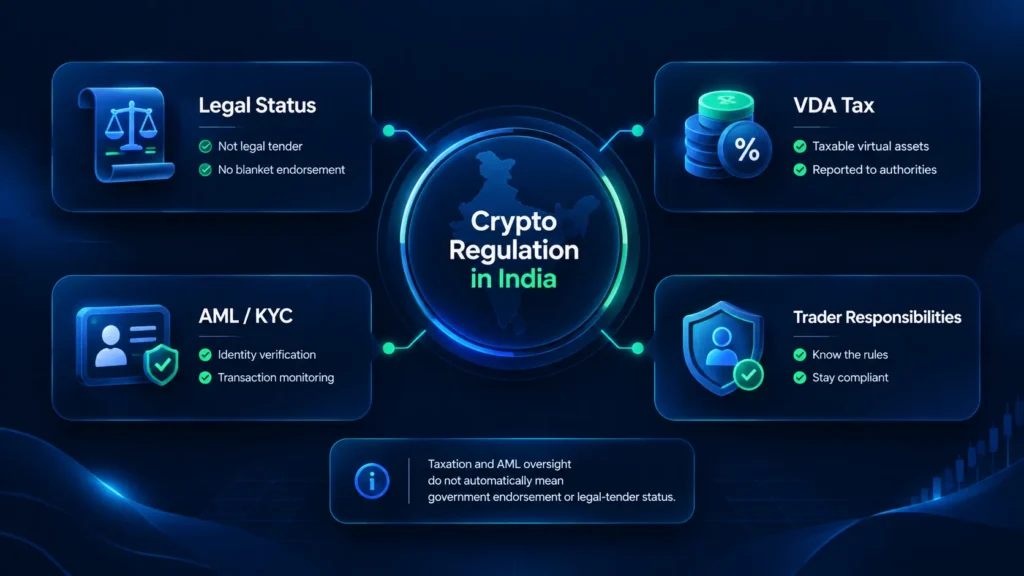
Rather than a single cryptocurrency law, India’s framework is assembled from several institutions acting within their existing mandates — monetary policy, taxation, and financial-crime prevention — each covering a different slice of the crypto ecosystem.
Role of Reserve Bank of India
The Reserve Bank of India has historically taken a cautious position toward private cryptocurrencies, citing concerns about consumer protection, monetary stability and the potential for misuse in illicit finance. The RBI’s core mandate covers currency issuance, payment systems and banking supervision, which is why it treats crypto assets differently from the digital rupee, its own Central Bank Digital Currency issued under central bank authority. Private crypto assets remain outside the RBI’s currency-issuing function even as the central bank continues expanding e₹ pilots.
Role of Ministry of Finance and Income-Tax Authorities
The Ministry of Finance and the Income Tax Department shape how crypto transactions are treated financially, primarily through the Virtual Digital Asset tax provisions introduced in the Finance Act, 2022. This branch of policy does not declare crypto legal or illegal; it defines how gains, transfers and reporting are handled once a person chooses to trade. Because tax law forms the most concrete part of the current framework, it is often the clearest reference point for understanding crypto trading tax in India.
Role of FIU-IND
The Financial Intelligence Unit-India (FIU-IND) functions as the anti-money-laundering supervisor for VDA service providers. It brought exchanges, wallet providers and similar service providers under the Prevention of Money Laundering Act, 2002 from March 2023, requiring registration with FIU-IND. Reporting entities are expected to monitor transactions and file suspicious transaction reports, giving FIU-IND a central role in tracking crypto-linked financial crime.
Prevention of Money Laundering Framework
Crypto exchanges and wallet platforms operating in India are classified as “reporting entities” under the Prevention of Money Laundering Act, which brings them into the same due-diligence structure historically applied to banks and financial intermediaries. This is why KYC document collection, customer verification and transaction record-keeping have become standard on Indian crypto platforms rather than optional features.
Evolution of Crypto Regulation in India
India’s crypto rules did not appear all at once — they built up through a sequence of banking restrictions, a court challenge, and new tax and AML legislation over roughly five years.
- 2018: RBI banking restriction on crypto-related businesses
- 2020: Supreme Court strikes down the RBI circular
- 2022: VDA tax framework introduced
- 2023: AML and FIU-IND oversight expanded to cover VDA service providers
- 2024–2026: Continued enforcement, cross-border reporting cooperation, and policy consultation
2018 Banking Restrictions
On 6 April 2018, the RBI issued a circular instructing regulated banks and financial institutions to stop providing services to any business dealing in cryptocurrencies. The circular did not outlaw holding or trading crypto directly, but by cutting exchanges off from banking channels it made converting rupees to crypto and back practically difficult, and it remains one of the most cited episodes in Indian crypto history.
2020 Supreme Court Decision
On 4 March 2020, the Supreme Court decided Internet and Mobile Association of India v. Reserve Bank of India, a case brought after an industry body representing crypto exchanges challenged the RBI’s 2018 circular. The Court set aside the circular on proportionality grounds, restoring banking access for crypto businesses. Importantly, the ruling addressed the RBI’s banking restriction rather than declaring cryptocurrency a fully regulated or officially sanctioned asset class — the judges held that virtual currencies had not acquired the status of legal tender because they are not backed by a central authority.
2022 VDA Tax Framework
The Finance Act, 2022 introduced dedicated tax provisions for Virtual Digital Assets, creating a specific tax category for crypto for the first time. This gave crypto transactions formal tax treatment distinct from how equities, mutual funds or other capital assets are taxed, and it effectively became India’s clearest legislative statement on how crypto activity is handled financially.
2023 AML and FIU-IND Expansion
In March 2023, the government extended the Prevention of Money Laundering Act to cover VDA-related activities, requiring exchanges and wallet providers — including many offshore platforms serving Indian users — to register with FIU-IND, apply KYC procedures and report suspicious transactions.
Current Regulatory Position
India’s current framework rests on three pillars working in parallel: income-tax rules that classify and tax VDAs, PMLA-based AML supervision run through FIU-IND, and the RBI’s separate monetary stance that excludes private crypto from legal-tender status. A comprehensive framework paper involving several government bodies has reportedly been under joint consultation, and India has also been implementing the OECD’s Crypto-Asset Reporting Framework (CARF) for cross-border tax information exchange from 2026, signalling that today’s rules are a stage in an ongoing process rather than a finished system.
Crypto Tax Rules and Trader Responsibilities

Once someone decides to buy or sell crypto in India, tax treatment becomes the most concrete and consistently enforced part of the legal landscape, independent of whether a person considers themselves an investor or an active trader.
Virtual Digital Asset Tax Treatment
Crypto assets, including Bitcoin, Ethereum, other tokens and NFTs, are classified as Virtual Digital Assets under the Income Tax Act. It is worth separating this from legal-tender status or conventional securities classification — VDA treatment is a tax label, not a declaration that crypto is officially regulated money or a listed security.
Tax on Income From VDA Transfers
Income from transferring a VDA is taxed at a flat rate of 30%, applied regardless of the holding period or the trader’s overall income slab. No deductions are allowed except the cost of acquisition, and losses from one VDA cannot be set off against gains from another VDA or carried forward to future years. This structure differs meaningfully from how capital gains on stocks or mutual funds are typically treated.
| Tax Element | Rule |
| Tax rate on VDA transfer income | Flat 30% |
| Allowed deductions | Cost of acquisition only |
| Loss set-off | Not permitted against other income or VDAs |
| TDS rate | 1% under Section 194S |
| TDS threshold | Generally ₹50,000 (₹10,000 for specified persons) per financial year |
1% TDS on VDA Transactions
A 1% Tax Deducted at Source applies to qualifying VDA transfers, generally withheld by the platform or payer at the time of the transaction. The purpose of TDS is to create a data trail that tax authorities can cross-check against a trader’s filed returns. How the withholding is applied can differ depending on whether the transaction happens through a registered exchange, a peer-to-peer transfer, or an international platform, which is one reason transaction structure matters for compliance purposes.
Tax Reporting and Transaction Records
Traders are generally expected to retain records of purchase dates, acquisition costs, transfer values and any TDS deducted, since India’s tax authorities have introduced a dedicated schedule in income tax returns for reporting these transactions. Reliable record-keeping supports accurate self-reporting and helps reconcile a trader’s own figures against exchange-reported data, without this article functioning as a step-by-step filing guide.
KYC, AML and Exchange Compliance
Beyond taxation, the second major compliance layer for anyone engaging in crypto trading in India runs through anti-money-laundering supervision, which shapes how platforms onboard and monitor users.
KYC Requirements for Crypto Platforms
Registered VDA service providers collect identity documents, proof of address and other customer information as part of standard KYC procedures, mirroring practices long used by banks. This process exists to verify who is transacting on a platform and to support the broader AML framework, rather than being an optional feature exchanges add voluntarily.
FIU-IND Registration for VDA Service Providers
FIU-IND registration requirements are aimed at businesses providing VDA services — exchanges, custodial wallet providers and similar intermediaries — not at individual traders using those platforms. A growing number of exchanges, both domestic and offshore, are now registered as reporting entities under PMLA.
Transaction Monitoring and Suspicious Activity
Registered platforms apply automated and manual monitoring to flag unusual transaction patterns, such as rapid transfers, structuring designed to avoid reporting thresholds, or connections to sanctioned addresses. Flagged activity can trigger additional verification requests or a suspicious transaction report filed with FIU-IND, a process modeled on existing banking AML practice.
Source of Funds and Transaction Traceability
Blockchain ledgers are, by design, publicly traceable, and when combined with exchange KYC records and banking transaction history, they can create a fairly detailed trail connecting a wallet address to a real identity. This traceability is one reason documentation — bank statements, exchange trade histories, wallet records — can become relevant if a transaction is later reviewed by tax or enforcement authorities.
Crypto Exchange Responsibilities in India
Platforms that serve Indian users, whether based domestically or offshore, carry compliance obligations distinct from those of the individual traders who use them.
Compliance Requirements for Indian-Facing Platforms
Any crypto trading platform serving Indian customers is expected to maintain AML and KYC procedures, register with FIU-IND where applicable, and keep transaction records available for regulatory review. Enforcement action has already been taken against some offshore exchanges for PMLA violations, illustrating that these requirements are actively supervised rather than merely theoretical.
Registered Platform Does Not Mean Government Endorsement
FIU-IND registration confirms that a platform meets certain AML/KYC obligations — it is not a certification of asset quality, platform solvency, profitability or consumer protection. A registered exchange can still experience security breaches, operational failures, or insolvency, so registration status should not be read as a safety guarantee.
Offshore Exchange Considerations
Using a platform based outside India can introduce additional questions around whether the exchange has registered with FIU-IND, how foreign-exchange rules apply to fund transfers abroad, and how tax reporting obligations are met when a platform does not issue Indian TDS certificates. Not every offshore platform or transaction carries identical legal treatment, and the specifics can depend on the platform’s registration status and the nature of the transaction.
Activities With Additional Legal Considerations
Some crypto-related activities sit outside straightforward spot trading and can introduce extra legal, tax or counterparty questions.
- P2P crypto trading — direct transactions between individuals, which can raise additional counterparty, fraud, banking and AML considerations compared with exchange-based trades
- Crypto payments — using crypto to pay for goods or services, distinct from trading or holding it, since private cryptocurrency is not legal tender
- Crypto futures, margin and derivatives — leveraged and contract-based products that can involve a different regulatory and contractual context than ordinary spot transactions
- Cross-border transactions — transfers involving foreign accounts or offshore platforms, which can intersect with foreign-exchange and cross-border tax rules
P2P Crypto Trading
Peer-to-peer transactions, where two individuals exchange crypto and fiat currency directly rather than through a centralized order book, can carry additional counterparty risk since there is no exchange acting as an intermediary. Banking transfers linked to P2P trades have also drawn scrutiny in some cases, and tax obligations on any resulting gains still apply in the same way as exchange-based trades.
Crypto Payments
Accepting or using cryptocurrency as payment for goods and services is legally distinct from simply trading or holding it as an asset, since crypto lacks legal-tender status. A merchant can choose to accept crypto voluntarily in a private arrangement, but no business is obligated to do so, and such arrangements do not convert crypto into official currency.
Crypto Futures, Margin and Derivatives
Products involving leverage, margin or derivative contracts on crypto assets introduce contractual structures — counterparty obligations, margin calls, liquidation mechanics — that differ from simply buying and holding a token. These products can also interact with different regulatory questions depending on where the platform offering them is based, and this article does not provide operational guidance on using them.
Cross-Border Crypto Transactions
Transfers involving offshore exchanges, foreign bank accounts or international wallet services can raise questions under India’s foreign-exchange regulations in addition to income-tax rules. The OECD’s Crypto-Asset Reporting Framework, which India has been implementing, is expected to increase information-sharing between jurisdictions on cross-border crypto holdings and transactions.
Trader Responsibilities Under Indian Crypto Rules
Regardless of platform choice, individuals trading crypto in India carry a consistent set of compliance responsibilities.
- Tax compliance — declaring taxable VDA-related income, accounting for the 30% flat rate, and complying with applicable TDS and reporting provisions
- Accurate KYC information — providing correct identity and account details to platforms subject to KYC obligations
- Transaction documentation — retaining records that establish the timing, value and nature of trades for potential tax or compliance review
- Compliance with applicable laws — recognizing that using cryptocurrency does not exempt anyone from general laws on fraud, money laundering, cybercrime or taxation
Risks and Limitations of Crypto Legal Status
The fact that crypto trading is currently permitted in India comes with meaningful limitations that are separate from the underlying financial risk of the assets themselves.
Limited Regulatory Protection
Crypto trading being legal does not carry the same protective infrastructure associated with regulated banking products or listed securities, such as deposit insurance, investor grievance redressal mechanisms tied to a dedicated regulator, or standardized disclosure requirements.
Regulatory Changes
India’s crypto framework has already changed substantially since 2018, and officials have indicated further policy work is ongoing, including a comprehensive framework paper under joint review by multiple government bodies. Tax rates, AML thresholds and reporting obligations could all be revised through future legislation or regulatory guidance.
Platform and Counterparty Risk
Exchanges and custodial services can experience security breaches, technical failures or insolvency, and FIU-IND registration does not eliminate these operational risks. High-profile security incidents at Indian exchanges in past years illustrate that platform risk exists independently of legal or tax compliance status.
Legal Status Does Not Remove Market Risk
Whether crypto trading is legal is an entirely separate question from whether crypto markets are stable or suitable for a given individual. Cryptocurrency prices are historically associated with high volatility, and legal permission to trade does not indicate anything about future price performance. Past performance does not guarantee future results, and losses in crypto markets may exceed initial expectations.
How Crypto Regulation Differs From Traditional Financial Assets
| Feature | Bank Deposits | Securities (Stocks/Bonds) | Cryptocurrency (VDA) | Digital Rupee (e₹) |
| Legal tender | No (rupee-denominated) | No | No | Yes |
| Central authority/issuer | Regulated bank, RBI oversight | Company/government, SEBI oversight | No central issuer | Reserve Bank of India |
| Deposit/investor protection | Deposit insurance (DICGC) | SEBI investor protection framework | None | Central bank backed |
| Tax treatment | Interest taxed at slab rate | Capital gains rules vary | Flat 30% + 1% TDS | Not applicable (currency) |
Crypto Compared With Bank Deposits
Bank deposits benefit from deposit insurance and direct RBI regulatory oversight, giving depositors a formal protection layer if a bank fails. Crypto holdings carry no equivalent insurance scheme, and their value is not backed by any central authority.
Crypto Compared With Securities
Shares and bonds fall under the Securities and Exchange Board of India’s regulatory framework, which includes disclosure requirements, listing rules and investor grievance mechanisms. Private crypto assets do not automatically receive this treatment, since no equivalent dedicated securities-style regulator currently governs them in India.
Crypto Compared With Digital Rupee
The digital rupee is issued directly by the Reserve Bank of India and carries legal-tender status, making it functionally equivalent to physical currency. Privately issued cryptocurrencies have no issuing central authority and remain outside the legal-tender category, which is the central distinction between the two even though both operate on digital rails.
FAQ: Is Crypto Trading Legal in India?
Is crypto trading legal in India?
Yes, buying, holding and selling cryptocurrency is legal in India, but it is not recognised as legal tender. Trading activity is subject to a 30% flat tax on gains, 1% TDS on qualifying transactions, and AML/KYC obligations that apply mainly to the platforms facilitating trades.
Is Bitcoin legal in India?
Bitcoin can be legally held and traded in India in the same way as other Virtual Digital Assets. It is not treated as official Indian currency, so it cannot be used to settle debts the way the rupee can, though private acceptance as payment is a separate matter from its legal trading status.
Is cryptocurrency legal tender in India?
No. Legal tender refers to currency that must be accepted for debt settlement and is backed by the state, which applies to the Indian rupee and the RBI-issued digital rupee. Private cryptocurrencies like Bitcoin do not carry this status, regardless of how widely they are traded.
Do crypto traders have to pay tax in India?
Yes, income from transferring Virtual Digital Assets is taxed at a flat 30% rate, with an additional 1% TDS applied on qualifying transactions. This tax treatment reflects how crypto income is classified financially and should not be interpreted as regulatory endorsement of the underlying asset.
Does India regulate crypto exchanges?
Crypto exchanges operating in India are required to register with FIU-IND and follow AML and KYC procedures under the Prevention of Money Laundering Act since March 2023. This is a financial-crime compliance framework rather than a comprehensive licensing regime comparable to how SEBI regulates securities markets.
Is crypto trading on offshore exchanges legal in India?
Using an offshore exchange is not automatically illegal, but it can raise additional questions around FIU-IND registration status, foreign-exchange rules and how Indian tax obligations are met without local TDS deduction. Some offshore platforms have registered with FIU-IND, while others have faced enforcement action, so outcomes vary by platform.
Is P2P crypto trading legal in India?
Peer-to-peer crypto trading is not banned, but it operates with fewer built-in protections than exchange-based trading, since there is no intermediary verifying the counterparty. Tax obligations on any gains still apply the same way as with exchange trades, and banking transfers linked to P2P deals can draw additional scrutiny.
Can cryptocurrency be used as payment in India?
Cryptocurrency can be used in a private payment arrangement if both parties agree, but it has no legal-tender status, meaning no business is required to accept it. This is a separate question from whether crypto trading itself is legal, which it is.
Are crypto futures and margin trading legal in India?
Crypto derivatives and margin products are not subject to a specific prohibition, but they involve a different regulatory and contractual context than ordinary spot buying and selling, particularly regarding the platform offering them and applicable leverage rules. This article does not provide guidance on using these products.
Can crypto regulations in India change?
Yes. India’s framework has evolved substantially since the 2018 RBI circular through the 2020 Supreme Court ruling, the 2022 tax rules and the 2023 AML expansion, and government bodies have continued consulting on further policy. Future legislation, tax amendments or regulatory guidance could change the requirements described in this article.