Crypto Trading in India: Market Access and Key Considerations for Beginners


Cryptocurrency trading in India refers to the buying, selling, and exchanging of digital assets such as Bitcoin (BTC) and Ethereum (ETH) through registered platforms. For someone new to crypto trading, crypto in India presents a distinct mix of opportunity and complexity: digital assets are actively traded and taxed, yet they are not recognized as legal tender.
Market access depends on exchange registration, INR banking connectivity, and Know Your Customer (KYC) procedures, while taxation follows a separate framework built around the concept of a Virtual Digital Asset (VDA). This article introduces the main issues a beginner typically encounters before choosing to start trading, including market structure, regulation, taxation, platform selection, risk, and trading instruments, presented in a neutral, informational format.
Key Takeaways
- Cryptocurrency is classified as a Virtual Digital Asset under India’s tax framework, not as legal tender or a recognized currency.
- Market access depends on the type of crypto exchange, available INR funding methods, KYC requirements, and platform compliance status.
- Crypto markets typically operate 24/7, unlike conventional Indian stock-market trading sessions.
- VDA income is commonly subject to a flat 30% tax under Section 115BBH, along with 1% TDS under Section 194S on qualifying transactions.
- Futures and options on crypto assets exist alongside spot trading, offering a different structure of exposure to BTC and ETH price movements.
- Crypto prices can be highly volatile, and regulatory or tax requirements in India may continue to evolve.
Crypto Trading in India: Market Access and Market Structure
Indian residents typically access cryptocurrency markets through centralized exchanges that support INR deposits, or through platforms offering crypto-to-crypto markets using stablecoins. Market structure in crypto differs meaningfully from India’s traditional stock exchanges, which affects how liquidity, pricing, and trading hours function for a beginner looking to begin trading.
How Crypto Markets Differ From Traditional Indian Markets
Cryptocurrency markets generally operate continuously, without the fixed opening and closing hours associated with the Bombay Stock Exchange or National Stock Exchange. Liquidity in crypto is drawn from a globally distributed, largely decentralized network of participants rather than a single national order book. This structure means that price movements, visible on a live chart at any hour, can occur on weekends as well as weekdays, which is a meaningful distinction for a trader accustomed to conventional Indian market sessions.
- Continuous 24/7 market availability across most crypto exchanges in India
- Liquidity sourced globally rather than from a single national exchange
- Decentralized settlement infrastructure underlying many blockchain-based assets
- No centralized circuit-breaker system equivalent to Indian equity markets
INR Access and Crypto-to-Crypto Markets
Trading pairs involving the Indian rupee, often referred to as crypto INR pairs, allow Indian users to deposit INR and convert rupees directly into assets such as BTC or ETH. Crypto-to-crypto pairs, by contrast, involve exchanging one digital asset for another — for example, trading ETH for a stablecoin like USDT — without an INR leg. The distinction matters because INR liquidity, deposit processing, and applicable fees can differ from crypto-to-crypto market activity.
| Pair Type | Example | Typical Use |
| INR pair | BTC/INR | Direct rupee-to-crypto conversion |
| Stablecoin pair | ETH/USDT | Crypto-to-crypto exposure without INR |
| Altcoin pair | SOL/BTC | Trading between two non-fiat assets |
Centralized Exchanges and Decentralized Platforms
A centralized crypto exchange, such as CoinDCX or CoinSwitch, holds custody of user funds and manages order matching internally through its own trading platform, which typically requires KYC verification before a trader can create an account and start trading. A decentralized exchange, by contrast, allows users to retain custody of their own assets and interact directly with blockchain-based liquidity pools, generally without the same account-verification process. Some platforms also expose an API, allowing more experienced users to connect external tools to their exchange account. Each structure carries different implications for custody, compliance, and liquidity depth.
Legal and Regulatory Position of Cryptocurrency in India
Cryptocurrency occupies a distinct legal category in India — it can be legally traded and taxed, yet it has not been granted the status of currency or a recognized security. Understanding this distinction is central to evaluating is crypto trading legal in India as a starting question for beginners.
Virtual Digital Asset Classification
The Finance Act 2022 introduced the term Virtual Digital Asset under Section 2(47A) of the Income Tax Act, defining it broadly to include cryptocurrencies, tokens, and non-fungible tokens generated through cryptographic means. This classification places digital assets within India’s tax code as a distinct income category, separate from stocks, mutual funds, or foreign currency, and it does not equate to recognition as legal tender.
Role of RBI, SEBI and FIU-IND
Several Indian institutions play distinct roles relevant to digital assets. The Reserve Bank of India (RBI) oversees monetary policy and banking-sector stability and has expressed caution regarding crypto assets in the past, while the Securities and Exchange Board of India (SEBI) regulates securities markets, a category that does not currently include cryptocurrency. The Financial Intelligence Unit – India (FIU-IND) is responsible for anti-money-laundering oversight, and crypto exchanges in India are generally expected to register with FIU-IND as reporting entities.
- RBI: monetary and banking-system oversight
- SEBI: securities-market regulation (not currently applicable to crypto)
- FIU-IND: anti-money-laundering compliance and exchange registration
KYC and Anti-Money-Laundering Requirements
Crypto exchanges operating in India typically require identity verification, commonly referred to as KYC, before allowing deposits or trading activity. This process is generally linked to AML compliance obligations under the Prevention of Money Laundering Act, and it can involve submission of a PAN card, Aadhaar-linked verification, and bank-account confirmation. A FIU-registered platform is one that has completed this regulatory registration process.
Regulatory Developments and Ongoing Uncertainty
India’s cryptocurrency framework has evolved gradually since 2018, moving from an RBI banking restriction that was later overturned by the Supreme Court, to the introduction of VDA taxation in 2022. Reporting requirements, exchange registration expectations, and tax provisions have continued to develop, and further regulatory change remains possible as policymakers assess the asset class.
Crypto Taxation and Reporting Considerations
Cryptocurrency transactions in India are subject to a distinct tax framework introduced through the Finance Act 2022. The following sections describe the general structure of this framework; individual circumstances can vary, and this content does not constitute personalized tax advice. For a deeper look at this topic, see crypto trading tax in India.
30% Tax Treatment for VDA Income
Under Section 115BBH of the Income Tax Act, income from the transfer of a VDA is commonly taxed at a flat rate of 30%, plus applicable surcharge and a 4% health and education cess. This rate is generally understood to apply uniformly, regardless of the holding period or the trader’s overall income slab, which differs from the slab-based or capital-gains treatment used for many other asset classes.
1% TDS on Qualifying VDA Transactions
Section 194S introduces a 1% tax deducted at source on qualifying VDA transactions. On exchanges in India, this deduction is typically handled by the platform itself at the time of transfer, once transaction value crosses specified thresholds within a financial year. TDS is generally understood to serve as a mechanism for tracking transaction activity for tax-reporting purposes, rather than as an additional standalone tax burden beyond the amount later adjusted against total tax liability.
Losses, Deductions and Cost of Acquisition
Under the VDA framework, the only deduction typically permitted against transfer income is the original cost of acquiring the asset. Losses from one VDA transaction are generally not permitted to offset gains from another VDA or from unrelated income sources, and VDA losses are typically not eligible to be carried forward to future financial years.
Crypto-to-Crypto Transactions and Tax Events
Exchanging one digital asset for another — for example, trading BTC for ETH — can itself constitute a taxable transfer event under the VDA framework, even when no INR is involved at any stage. This is a distinction beginners sometimes overlook, since no rupee conversion appears to have taken place in the transaction.
Record-Keeping and Tax Reporting
Maintaining transaction records is often considered a practical aspect of participating in crypto markets in India. Relevant documentation can include purchase and sale dates, cost of acquisition, transaction fees, TDS certificates, and wallet-transfer histories, which may be referenced when preparing an income tax return under the applicable VDA schedule.
Choosing Crypto Market Access: Platforms and Account Considerations
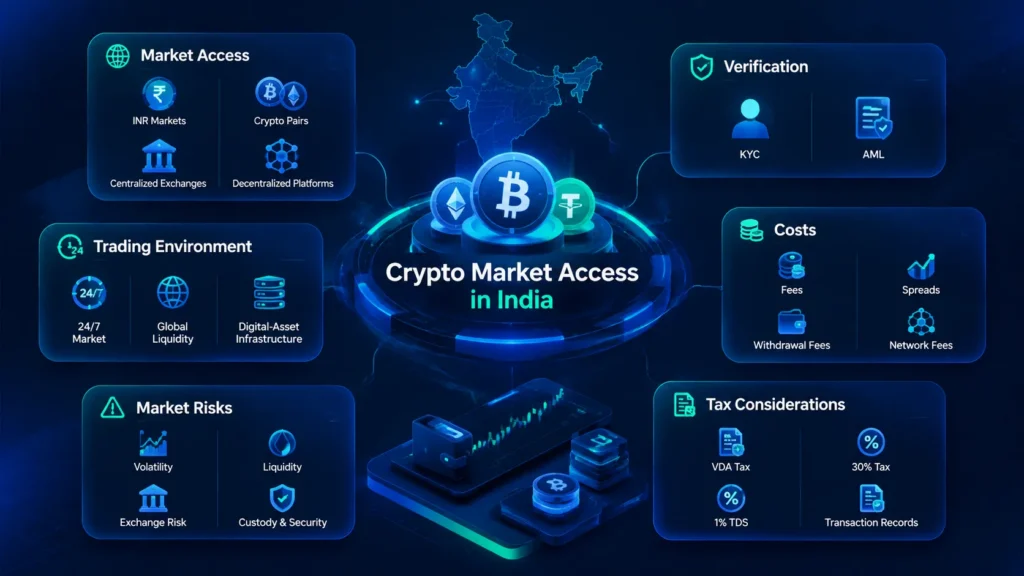
Selecting an exchange platform in India for crypto market access typically involves several practical factors. This section outlines common considerations without recommending a specific exchange or trading platform.
Exchange Registration and Compliance Status
Whether an exchange is FIU-registered, its jurisdiction of operation, and its stated AML and KYC procedures are commonly reviewed factors. A leading crypto exchange operating in India is generally expected to maintain transparent registration status, published compliance information, and a seamless account-creation process for new users looking to start crypto trading.
Trading Pairs and Available Assets
Platforms differ in the range of supported cryptocurrencies, INR pairs, and stablecoin pairs available to buy crypto. Some exchanges offer a broad selection spanning BTC, ETH, XRP Ledger-based assets, Solana, Dogecoin, and Shiba Inu, while others maintain a narrower set of listings.
Fees, Spreads and Withdrawal Costs
Trading fees in India vary by platform and can include maker-taker fee structures, bid-ask spreads, deposit INR charges, and withdrawal costs. Some platforms are associated with low fees on trading activity but comparatively high withdrawal fees, which can influence the total cost of a transaction cycle.
| Cost Component | Description |
| Trading fee | Charged per buy/sell order, often tiered by volume |
| Spread | Difference between best bid and best ask price |
| Deposit fee | Cost associated with funding an account via INR or crypto |
| Withdrawal fee | Cost of moving funds off the platform |
| Network fee | Blockchain transaction cost for on-chain transfers |
Liquidity and Order Execution
Deep liquidity on an exchange generally means that larger orders can be filled with less price impact, contributing to a more seamless trading experience overall. Lower liquidity, by contrast, can widen the gap between the displayed price and the price at which an order is ultimately executed, a phenomenon commonly referred to as slippage.
Crypto Trading Risks Relevant to Indian Beginners
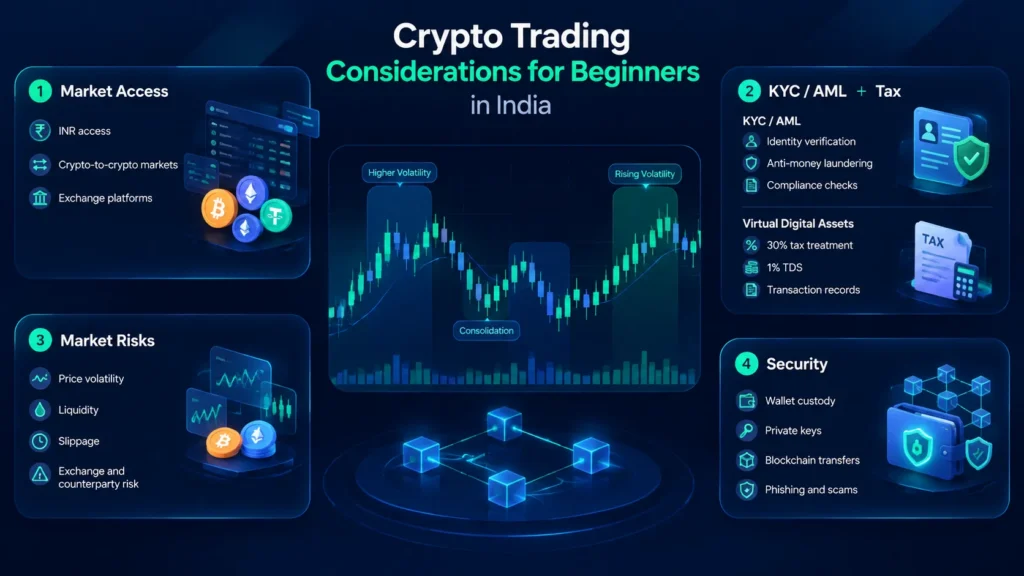
Cryptocurrency markets carry a distinct risk profile compared with conventional Indian asset classes such as stocks or government bonds. Understanding these risks is a component of informed market participation.
Price Volatility and Market Cycles
Crypto asset prices, including BTC and ETH, have historically experienced substantial short-term price swings visible on any trading chart, often described in terms of multi-year market cycles. Volatility of this magnitude is generally considered more pronounced than what is typically observed in large-cap Indian equities.
Liquidity and Slippage
In periods of lower trading volume, the gap between the quoted price and the executed price can widen, a dynamic that may be more pronounced in less-traded altcoins compared with trading BTC or ETH.
Exchange and Counterparty Risk
Platform outages, temporary withdrawal restrictions, and, in some historical cases, exchange insolvency are risks associated with centralized crypto platforms. The collapse of exchanges such as WazirX in connection with a major security breach has been cited as an example of counterparty risk within the Indian crypto ecosystem.
Wallet and Private-Key Security
Assets held on an exchange are generally under the platform’s custody, while assets moved to a personal wallet are controlled through a private key. Loss or compromise of a private key in self-custody arrangements is typically understood to result in permanent loss of access to the associated funds.
Scams, Fraud and Social-Engineering Risks
Fraudulent investment schemes, phishing attempts, impersonation of legitimate platforms, and misleading promotional claims are documented risks within the broader cryptocurrency space. Independent verification of a platform’s registration status is commonly cited as one way to reduce exposure to fraudulent schemes.
- Fake or cloned exchange websites
- Impersonation of support staff or influencers
- Unrealistic guaranteed-return promises
- Unsolicited investment “opportunities” via messaging apps
Crypto Trading Methods and Market Instruments
Several distinct methods of trading in crypto markets exist, ranging from direct ownership to derivative contracts such as futures and options.
Spot Crypto Trading
Spot trading refers to directly buying and owning cryptocurrencies at the current market price, with settlement typically occurring close to immediately. Spot market transactions represent the most straightforward form of crypto exposure, involving direct custody or exchange-held ownership of the underlying coin, and are often where a beginner will start trading before exploring more complex instruments.
Margin and Leveraged Trading
Leverage allows a trader to control a larger position size using a smaller amount of deposited capital, which can amplify both potential gains and potential losses. Margin and leveraged positions can also introduce liquidation risk, where a position may be automatically closed if the market moves against it beyond a defined threshold.
Crypto Futures and Derivatives
A futures contract is a derivative instrument whose value is tied to an underlying crypto asset, such as BTC, without requiring direct ownership of the coin itself. Crypto futures trading and crypto options together make up what is broadly described as futures and options (F&O) exposure, distinct from spot transactions in that they involve a contractual agreement rather than direct asset transfer.
P2P Crypto Trading
Peer-to-peer (P2P) crypto trading involves direct transactions between individual participants, often facilitated by an escrow mechanism provided by the platform. P2P markets can support a range of payment methods, including bank transfer, and generally involve additional counterparty considerations compared with order-book trading on a centralized exchange.
Factors That Can Influence Crypto Markets in India
Multiple overlapping forces can affect cryptocurrency prices and participation levels within the Indian market.
Global Crypto Market Movements
BTC and major altcoin price movements originating in global markets typically influence INR-denominated crypto prices, since exchanges in India generally reference international liquidity and pricing benchmarks.
INR Exchange Rates and Global Pricing
Because most cryptocurrencies are priced globally in US dollars before being converted, movements in the INR/USD exchange rate can influence the rupee-denominated price of assets like BTC, independent of the underlying dollar price.
Regulation, Tax Policy and Government Announcements
Announcements related to VDA tax policy, TDS thresholds, or exchange-registration requirements have historically been associated with shifts in trading volume and market sentiment among Indian participants.
Technology, Network Activity and Market Sentiment
Blockchain network upgrades, transaction activity, and broader news flow can influence sentiment toward specific assets. Increased use of algorithmic crypto trading strategies and automated tools, sometimes accessed through an Algo Marketplace or connected via an API, has also been associated with shifts in short-term trading activity.
Practical Considerations Before Accessing Crypto Markets
A number of practical, non-instructional factors are commonly reviewed before beginning to engage with crypto markets in India.
Account Verification and Platform Access
Typical account-verification requirements include submission of a government-issued identity document, PAN details, and confirmation of a linked bank account. To create an account on most exchanges in India, some platforms may apply additional checks depending on transaction volume or jurisdiction.
Deposits, Withdrawals and Banking Connectivity
INR deposits are commonly processed through UPI, IMPS, or bank transfer, with some platforms allowing an account to deposit INR with amounts as little as ₹100 to start crypto activity. Processing times, transaction limits, and occasional banking-channel restrictions can all affect the overall deposit and withdrawal experience.
Custody and Asset Transfers
Crypto transfers differ from conventional bank transfers in that they rely on wallet addresses and blockchain-network confirmation rather than a centralized clearing system. Transactions recorded on a blockchain are generally irreversible once confirmed, which differs from the dispute or reversal mechanisms available in traditional banking.
Transaction History and Documentation
Maintaining an accurate transaction history, including records of deposits, withdrawals, trades, and TDS certificates, can be relevant for tax reporting, personal accounting, and resolving potential disputes with a platform.
FAQ: Crypto Trading in India
Is crypto trading legal in India?
Cryptocurrency trading is permitted in India and is subject to taxation under the VDA framework, but this does not mean cryptocurrencies are recognized as legal tender. Trading activity itself has not been banned, though it remains distinct from regulated securities trading.
Is cryptocurrency legal tender in India?
Cryptocurrency is not recognized as legal tender in India. The Indian rupee remains the only government-issued currency with legal-tender status, while crypto assets are treated as property-like Virtual Digital Assets for tax purposes.
How is cryptocurrency taxed in India?
VDA income is commonly taxed at a flat 30% rate under Section 115BBH, with only the cost of acquisition deductible. A separate 1% TDS applies under Section 194S on qualifying transactions, generally deducted by the exchange at the point of transfer.
What is 1% TDS on crypto transactions?
The 1% TDS under Section 194S is a tax deducted at source on qualifying VDA transfers once transaction value crosses specified thresholds within a financial year. It functions primarily as a transaction-tracking and compliance mechanism rather than a separate final tax.
Do crypto-to-crypto exchanges have tax implications?
Exchanging one VDA for another, such as trading BTC for ETH, can constitute a taxable transfer event under Section 115BBH, even though no INR is directly involved in the transaction.
Are crypto exchanges available to Indian users?
Access varies by platform, with availability depending on FIU-IND registration status, supported INR payment methods, and each exchange’s own compliance and jurisdictional policies. Not all global exchanges offer full services to Indian residents.
Can Indian users trade crypto 24/7?
Cryptocurrency markets generally operate continuously, without the fixed trading sessions used by Indian stock exchanges like the NSE or BSE, allowing order placement and execution at any hour, including weekends.
What are the main risks of crypto trading in India?
Key risks include price volatility, liquidity-related slippage, exchange or counterparty risk, wallet and private-key security, evolving tax and regulatory requirements, and exposure to scams or fraudulent schemes.
What is the difference between spot and futures crypto trading?
Spot trading involves directly buying and owning the underlying crypto asset at the current market price, while futures trading involves a derivative contract whose value tracks the underlying asset without requiring direct ownership of the coin.
Why are KYC requirements important for crypto exchanges?
KYC verification allows exchanges to confirm user identity, supports compliance with AML regulations enforced through FIU-IND registration, and enables transaction monitoring that is generally required for legal operation in India.