
What Is Crypto Trading? Definition, Market Structure, and Key Terms


Crypto trading refers to the buying, selling, or exchanging of digital currencies such as Bitcoin, Ethereum’s native asset Ether, and other cryptocurrencies, generally through a crypto trading venue such as a cryptocurrency exchange.
This article explains what cryptocurrency trading means in practice, how spot and derivatives markets differ, and how centralized and decentralized venues fit into the broader cryptocurrency market. It also covers order books, liquidity, trading pairs, and the terminology most often encountered when reading market data.
Key Takeaways
- Crypto trading involves transactions in digital currencies or in contracts linked to their prices, across spot and derivatives markets.
- Spot markets involve direct exchange of the underlying cryptocurrency, while derivatives markets involve contracts referencing an asset’s price.
- Cryptocurrency exchanges act as intermediaries, while decentralized platforms rely on smart contracts and liquidity pools.
- Order books, bids, asks, spreads, and liquidity together shape how a cryptocurrency transaction is matched and executed.
- Terms such as market capitalization, volatility, mining, and funding rate are commonly used to interpret market information.
- Market structure — the organization of venues, participants, and blockchain infrastructure — can influence pricing, execution, and overall market behavior.
What Is Crypto Trading?
Crypto trading, in broad terms, describes market activity involving digital currencies rather than the simple act of holding them. It is generally understood as distinct from long-term ownership, since it typically involves more frequent transactions tied to observed price movements across different venues and instruments.
Crypto Trading Definition
Crypto trading is commonly described as the exchange of cryptocurrencies, tokens, or related contracts, with each cryptocurrency transaction shaped by price movements, the venue used, and the behavior of other market participants. Traders may trade cryptocurrencies on a centralized cryptocurrency exchange, a decentralized platform, or through over-the-counter arrangements. The specific instrument used — spot asset or derivative — often determines how a transaction is structured and settled.
Crypto Trading vs Crypto Investing
Crypto trading and crypto investing are often distinguished by time horizon and transaction frequency rather than by the digital currencies involved. Investing is typically associated with holding a cryptocurrency over a longer period, while trading generally involves more frequent transactions responding to shorter-term price movements. Both approaches can involve different types of market exposure, from direct ownership held in a digital wallet to derivative contracts.
What Can Be Traded in Crypto Markets
Crypto markets encompass several categories of instruments beyond a single cryptocurrency. Common examples include:
- Cryptocurrencies and other virtual currencies such as bitcoin — widely regarded as the first cryptocurrency — and ether, the native asset of the Ethereum blockchain platform
- Tokens built on blockchain technology, including utility and governance tokens
- Stablecoins, which are designed to track a reference asset
- Derivatives such as futures, options, and perpetual contracts linked to an underlying digital currency
Why Crypto Markets Operate Differently
Crypto markets are often described as structurally different from traditional financial markets in several respects. Continuous operation, global participant access, blockchain-based settlement across a network of computers, and fragmented liquidity across many venues are frequently cited as defining characteristics. Because most cryptocurrencies are not issued or backed by a central bank, pricing and execution conditions may vary between platforms rather than reflecting a single, unified market.
How Crypto Market Structure Works

Market structure refers to how venues, participants, instruments, and rules combine to allow a market to function, rather than to chart-based patterns sometimes referenced in short-term trading commentary. Understanding this structure can help clarify how prices form and how a cryptocurrency transaction is ultimately settled.
Spot Markets
Spot markets are venues where the underlying digital currency itself is exchanged, with ownership generally transferring to the buyer’s digital wallet as part of the transaction. Spot prices are often treated as a reference layer for broader crypto pricing, since many derivative instruments are valued relative to spot-market activity. For a closer look at this mechanism, see what spot trading in crypto is.
Derivatives Markets
Derivatives such as futures, options, and perpetual contracts derive their value from an underlying cryptocurrency without necessarily involving direct ownership of that asset. These instruments commonly involve concepts such as contract size, leverage, margin, funding payments, and liquidation thresholds. Because exposure can exceed the capital directly committed, derivatives are generally described as carrying additional complexity relative to spot transactions.
OTC Markets
Over-the-counter (OTC) markets involve privately negotiated transactions that take place outside a conventional public order book. This structure is often associated with large transactions, where executing directly on a crypto exchange could otherwise have a more noticeable effect on the visible market price. OTC execution differs from exchange-based trading in that pricing and settlement terms are typically arranged directly between counterparties.
Centralized Exchanges
A centralized cryptocurrency exchange functions as an intermediary that provides trading infrastructure, order matching, custody arrangements, and market data to participants. A useful distinction is between the exchange itself and the underlying blockchain technology on which a digital currency may ultimately settle — the two operate as separate layers, and users typically hold balances on the exchange rather than in their own digital wallet unless they withdraw funds. Many beginners are first introduced to crypto markets through a crypto trading platform of this type.
Decentralized Exchanges
Decentralized exchanges rely on smart contracts, verified across a distributed network of computers, rather than a central intermediary to facilitate transactions. Many use automated market makers, which price assets algorithmically using liquidity pools instead of a traditional order book. This model can broaden access to a wider range of tokens, though it also introduces considerations specific to smart-contract-based infrastructure.
| Venue Type | Structure | Typical Role |
| Centralized Exchange | Intermediary-operated order book | Order matching, custody, market data |
| Decentralized Exchange | Smart contracts, liquidity pools | Automated pricing without a central intermediary |
| OTC Market | Privately negotiated | Large or customized transactions |
How Crypto Trades Are Matched
The mechanics behind how a cryptocurrency transaction is executed generally involve the interaction between buy-side and sell-side interest recorded on a given venue. This process is typically described in conceptual terms rather than as an operational procedure.
Order Books
An order book is commonly understood as a real-time record of outstanding buy and sell orders for a specific trading pair. It displays price levels alongside the quantity of a digital currency available at each level, offering a view of available market liquidity at a given moment.
Bids and Asks
The bid refers to the highest price a buyer is currently willing to pay, while the ask refers to the lowest price a seller is currently willing to accept. The relationship between these two figures is often used to interpret current market conditions and the general balance between buying and selling interest.
Bid-Ask Spread
The bid-ask spread is the difference between the highest bid and the lowest ask on a given venue. A narrower spread is generally associated with a more liquid market, while a wider spread may indicate lower liquidity or higher uncertainty. Spreads can vary by asset, venue, and prevailing market conditions.
Market Orders and Limit Orders
Two commonly referenced order types are market orders, which are designed to execute against currently available liquidity, and limit orders, which specify a particular price condition. Each type reflects a different relationship between execution certainty and price control, rather than representing a recommended approach for any specific situation.
Market Depth and Slippage
Market depth describes the total volume of orders available across different price levels, while slippage refers to the difference between an expected price and the price at which a transaction is ultimately executed. Thinner liquidity is often associated with greater sensitivity to larger transaction sizes, which can contribute to more pronounced slippage, particularly for highly volatile digital currencies.
Crypto Trading Pairs and Price Formation
Cryptocurrency prices are generally quoted in relation to another asset, and this relationship shapes how prices are interpreted across different platforms.
Trading Pairs
A crypto trading pair, such as BTC/USD or ETH/USDT, expresses the value of one digital currency — the base asset — in terms of another, the quote asset. In the ETH/USDT example, Ethereum’s native cryptocurrency, Ether, is priced relative to the stablecoin USDT.
Crypto Price
There is generally not a single universal price for a given cryptocurrency across every venue at any given moment. Differences in liquidity, order flow, participant composition, and exchange infrastructure can all contribute to modest price variations between platforms trading the same digital currency.
Price Discovery
Price discovery describes the ongoing process through which the collective orders and transactions of market participants establish observable market prices. This process is continuous in crypto markets, given their round-the-clock operation across globally distributed venues.
Liquidity and Trading Volume
Liquidity and trading volume are related but distinct concepts. Trading volume measures completed transaction activity over a defined period, while liquidity describes the availability of orders or counterparties around the current price. A market can show high volume at a given moment without necessarily reflecting deep, consistent liquidity.
Key Crypto Trading Terms
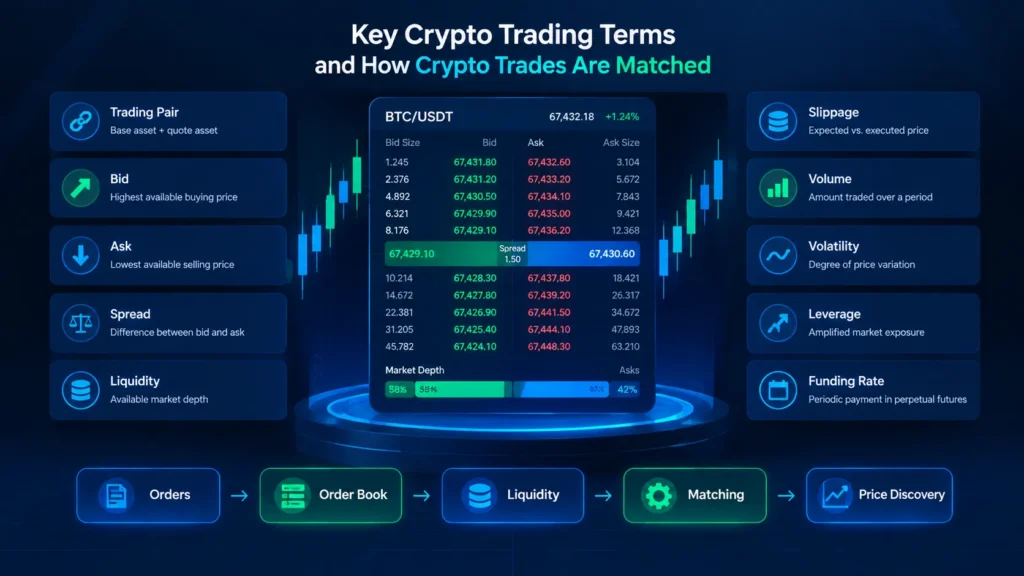
This glossary-style section outlines terminology frequently encountered on a cryptocurrency exchange interface, market data platform, or educational resource.
Spot Price
The spot price refers to the current market price associated with a digital currency in the spot market, reflecting the most recent level at which a transaction or quote has occurred.
Market Capitalization
Market capitalization is commonly calculated by multiplying a cryptocurrency’s current price by its circulating supply. It is generally used as an indicator of relative size rather than as a measure of trading activity, which is captured separately by volume.
Trading Volume
Trading volume represents the total quantity of a digital currency transacted within a specific market or time period. It is often used alongside price data to assess the level of activity associated with a given price movement.
Liquidity
Liquidity describes the ease with which a cryptocurrency can be bought or sold without materially affecting its price. Markets with higher liquidity can generally accommodate transactions with comparatively less price disruption than thinner markets.
Volatility
Volatility refers to the degree or rate of price variation over a given period. Cryptocurrencies are often considered highly volatile relative to some traditional asset classes, reflecting factors such as market size, participant composition, and information flow.
Market Maker and Market Taker
A market maker generally provides liquidity by placing resting orders on the order book, while a market taker consumes available liquidity by executing against those existing orders. This distinction is often used to describe different roles within order-book-based trading.
Slippage
Slippage refers to the difference between an expected execution price and the price at which a transaction is ultimately completed. It can occur when available liquidity shifts between the time an order is placed and when it is filled.
Leverage and Margin
Leverage refers to exposure that exceeds the amount of capital directly committed to a position, while margin refers to the collateral associated with a leveraged position. Leverage is generally described as amplifying both potential gains and potential losses, and it introduces additional considerations related to margin requirements and liquidation.
Funding Rate
Funding rates are periodic payments exchanged between long and short position holders in perpetual futures markets. They are generally designed to help keep a perpetual contract’s price aligned with the underlying spot market over time.
Open Interest
Open interest refers to the total number of outstanding derivative positions or contracts that have not yet been closed or settled. It is distinct from trading volume, which measures completed transactions rather than positions currently held.
Liquidation
Liquidation refers to the forced closing of a leveraged derivatives position, which can occur when margin requirements specified by a trading venue are no longer met.
Stablecoin
A stablecoin is a category of digital currency designed to maintain a relatively stable value relative to a reference asset, commonly a fiat currency issued by a central bank, such as the United States dollar.
Mining
Mining is the process, associated with certain blockchains such as Bitcoin’s, through which computer hardware connected to a network of computers validates transactions and creates new units of a cryptocurrency as a reward. It is generally described as one mechanism among several — alongside models used by other blockchain platforms — for securing and updating a shared ledger.
Factors That Shape Crypto Market Structure
Several broader factors influence how crypto markets are organized and how they function on a day-to-day basis.
Market Fragmentation
Crypto liquidity and trading activity are typically distributed across numerous cryptocurrency exchanges, blockchains, trading pairs, and liquidity pools rather than being concentrated in a single venue. This fragmentation can contribute to differences in pricing and execution conditions between platforms.
Blockchain Infrastructure
Network speed, transaction costs, and settlement mechanisms associated with a given blockchain platform, such as Ethereum, can influence activity on decentralized venues in particular. Since blockchain technology relies on a distributed network of computers rather than a single server, congestion or elevated transaction costs on that network may affect how efficiently a cryptocurrency transaction is processed.
Liquidity Conditions
Changing liquidity conditions can influence spreads, market depth, and the degree of price impact associated with a given transaction size. Periods of lower liquidity are often associated with wider spreads and greater sensitivity to order flow, particularly for highly volatile or less widely traded digital currencies.
Regulation and Market Access
Regulatory frameworks, asset classifications, and jurisdiction-specific requirements can affect which cryptocurrency trading services are available to participants in a given region. Regulatory approaches — including how central banks and financial regulators classify virtual currencies — continue to vary across jurisdictions and remain subject to change.
Crypto Trading Risks and Limitations
Crypto markets carry a number of structural risks that are generally considered alongside their conceptual mechanics.
Market Volatility
Rapid and substantial price movements can affect both spot and derivatives positions, sometimes within relatively short periods, reflecting the broader volatility often associated with cryptocurrency markets.
Liquidity Risk
Lower liquidity conditions can contribute to wider spreads, greater price impact, and more pronounced slippage, particularly for larger transaction sizes or less widely traded digital currencies.
Counterparty and Custody Risk
Risks associated with a cryptocurrency exchange or intermediary are generally distinct from risks associated with holding digital currencies directly in a personal digital wallet. Each arrangement carries its own considerations regarding custody and counterparty exposure.
Leverage and Liquidation Risk
Derivatives involving leverage can produce outcomes that are larger, in either direction, relative to the capital directly committed to a position, and liquidation can occur if margin requirements are not maintained. Regulatory data illustrates the scale of this risk: analyses of CFD trading across EU jurisdictions found that 74–89% of retail accounts typically lose money on these investments, with average losses per client ranging from roughly €1,600 to €29,000, according to the European Securities and Markets Authority. Past performance does not guarantee future results, and losses may exceed initial expectations.
Technology and Operational Risk
Blockchain network congestion, smart-contract vulnerabilities, crypto exchange outages, and cybersecurity incidents are among the operational considerations associated with crypto market infrastructure. These factors can affect the availability or reliability of trading and custody services.
FAQ
What is crypto trading in simple terms?
Crypto trading, in simple terms, refers to buying, selling, or exchanging digital currencies and related financial instruments across crypto markets. It typically involves more frequent transactions than long-term holding, and can take place through spot markets, derivatives, or OTC arrangements.
How does crypto trading work?
Crypto trading generally works through the interaction of trading venues, orders, and available liquidity. Market participants place orders that are matched according to a venue’s mechanism, with each cryptocurrency transaction ultimately settled either on-chain, using blockchain technology, or through the exchange’s internal systems.
What is the difference between spot and derivatives trading?
Spot trading involves the direct exchange of an underlying cryptocurrency, with ownership typically changing hands. Derivatives trading involves contracts whose value is linked to an underlying digital currency’s price, without necessarily requiring direct ownership of that asset.
What is a crypto trading pair?
A crypto trading pair expresses the value of one digital currency, the base asset, in terms of another, the quote asset. In BTC/USDT, for example, bitcoin is priced relative to the stablecoin USDT.
What is an order book in crypto?
An order book is a real-time record of outstanding buy and sell orders for a trading pair on a given venue. Bids represent buying interest and asks represent selling interest, together indicating available liquidity at different price levels.
What are bid, ask, and spread?
The bid is the highest price a buyer is currently willing to pay, and the ask is the lowest price a seller is currently willing to accept. The spread is the difference between these two figures, often used as an indicator of liquidity conditions.
What is liquidity in crypto trading?
Liquidity in crypto trading refers to the availability of market depth around the current price, which affects how easily a cryptocurrency transaction can be completed without materially moving that price. Higher liquidity is generally associated with narrower spreads and reduced price impact.
What is slippage in crypto?
Slippage refers to the difference between an expected execution price and the price at which a transaction is actually completed. It can arise when available liquidity changes between the time an order is submitted and when it is filled.
What is leverage in crypto trading?
Leverage refers to exposure that exceeds the capital directly committed to a position, with margin serving as the associated collateral. Leveraged exposure is generally described as carrying additional risk, including the possibility of liquidation if margin requirements are not maintained.
Why does crypto trading operate 24/7?
Crypto trading generally operates continuously because it relies on blockchain technology and settlement across a global network of computers rather than a centralized exchange with fixed operating hours, which distinguishes it from many traditional financial markets overseen by a central bank.